










PIRELLI AND THE UNIVERSITY OF MILAN-BICOCCA: 25 YEARS OF CORIMAV, MATERIALS RESEARCH AT THE HEART OF TYRE INNOVATION
The Consortium for Research on Advanced Materials celebrates 25th anniversary a quarter of a century
Joint research has led to technological solutions for increasingly innovative tyres
An Open Innovation model that has funded 44 scholarships and 65 PhDs, as well as delivering 28 patents and more than 250 scientific contributions related to the tyre sector
Twelve projects currently under way focusing on new materials, technologies and development methodologies
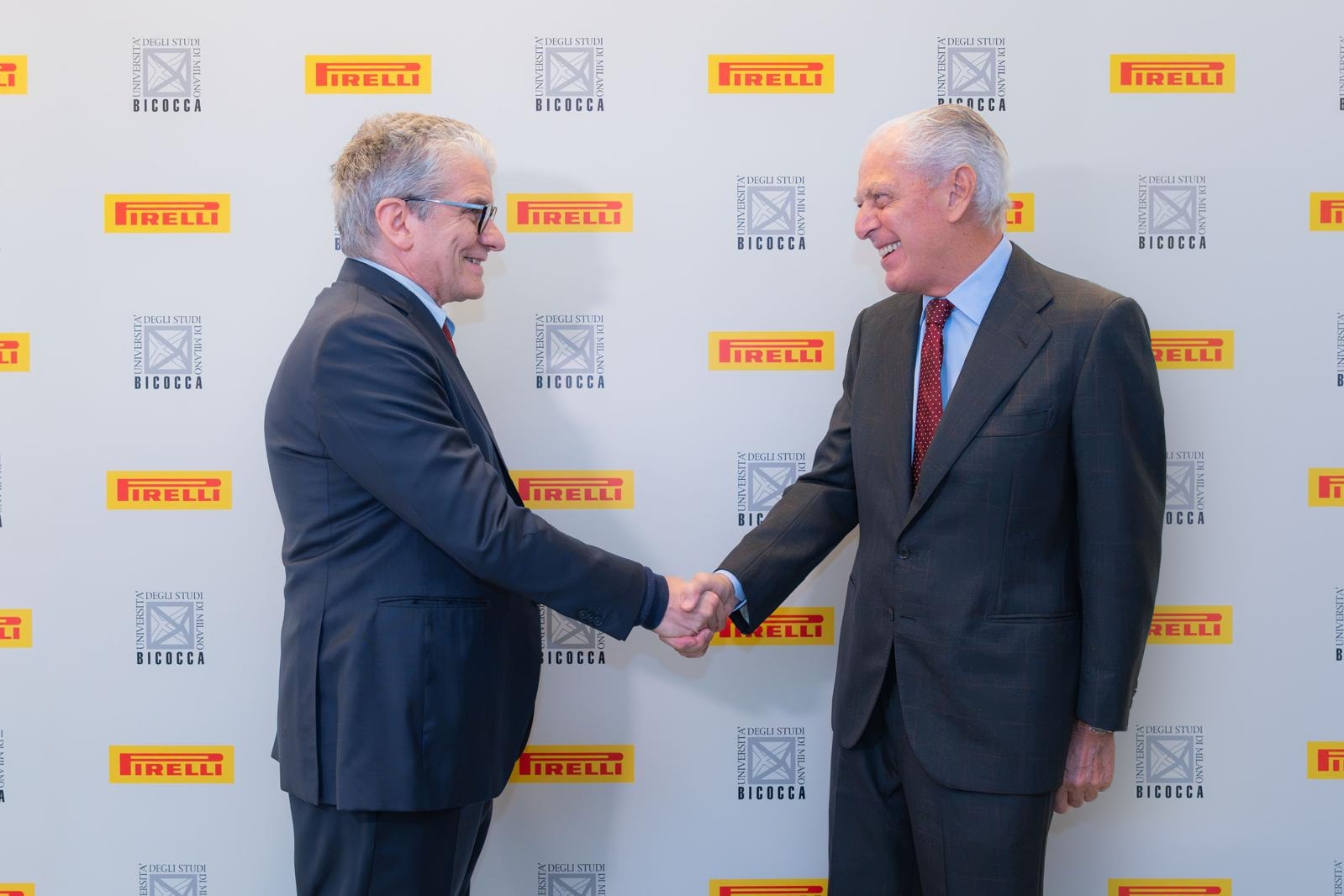
Milan, 26 November 2026 – Twenty-five years of joint research, education and technological development. Pirelli and the University of Milan-Bicocca today celebrate the 25th anniversary of CORIMAV (Consortium for Research on Advanced Materials), established in 2001 to bring together academic and industrial research and which, over the years, has become a model of Open Innovation. The collaboration has contributed to research into new materials, today one of the main drivers of innovation in the tyre industry in terms of performance, efficiency and safety. The anniversary was celebrated at the Pirelli Auditorium in Milan, with comments Marco Tronchetti Provera, Executive Chairman of Pirelli, and Marco Emilio Orlandi, Rector of the University of Milan-Bicocca.
Over its 25 years of activity, the Consortium has funded 44 scholarships, 65 PhDs and one researcher position, through programmes in which academic activity is developed in close contact with the needs and methodologies of industrial research. The skills acquired lead to professional opportunities in a range of fields, from academia and industry to entrepreneurship and science communication, and around 20% of CORIMAV PhD graduates go on to pursue a career at Pirelli. Its research activities have also resulted in 28 patents and 250 scientific contributions related to the tyre sector. It was precisely CORIMAV's ability to build a structured link between academia and industry that led the European Commission to include it, in 2018, in the Study on Fostering Industrial Talents in Research at European Level, dedicated to European experiences of mobility between research and industry.
The Minister for Universities and Research, Anna Maria Bernini, in a message sent for the event, said: “There is a form of intelligence that can only emerge from the coming together of different minds. It is the spark that ignites when the freedom of research engages in dialogue with the pragmatism of business. When two worlds choose to share a vision and discover that, together, they can go much further. Twenty-five years ago, Pirelli and the University of Milano-Bicocca had this very insight. CORIMAV was born out of this vision: an alliance between research and industry that anticipated the times and today stands as an ambitious model of collaboration. I would like to express my gratitude and best wishes to Pirelli, the University of Milano-Bicocca and everyone who has contributed to this experience. Twenty-five years is an important milestone. But the most valuable quality of those engaged in research is their ability to keep looking beyond the finish-line.”
Marco Tronchetti Provera, Executive Chairman of Pirelli, said: “Twenty-five years is an important milestone, but above all it provides a foundation from which to look ahead. CORIMAV has demonstrated the value of collaboration between academia and industry, bringing together different skills and approaches and turning research into tangible innovation. It is a model that we want to continue developing, opening it up to new expertise and new ideas, to address the technological challenges of the coming years and train new generations of researchers.”
Marco Emilio Orlandi, Rector of the University of Milan-Bicocca, said: “Today, technology transfer is an increasingly important mission for universities: it enables research results to find applications in the industrial world. Milan-Bicocca has invested in this process since the University was founded, as demonstrated by CORIMAV, which was established through our collaboration with Pirelli and has been active for 25 years in materials research and doctoral education. One of the achievements we are most proud of is seeing that the Consortium’s PhD graduates have found their professional path in academia or industry, including in Pirelli’s research and development.”
FROM MATERIALS RESEARCH TO NEW SOLUTIONS FOR TYRES
The Consortium began its journey with research focusing on nanocomposite materials, energy transmission (superconductivity and distributed generation) and molecular modelling.
Since 2010, in line with the company’s strategy, the focus has gradually shifted towards the tyre sector and research into new materials, including those of natural and recycled origin, capable of combining innovation with improved performance.
This model of knowledge exchange and cross fertilization has evolved over the years into an Open Innovation platform capable of developing academic and industrial expertise and accelerating the development of new solutions and technologies.
The Consortium’s activities in the field of materials science have generated know-how and new solutions. One example is lignin, a natural material derived from waste biomass with antioxidant properties which, following certain chemical and physical modifications, contributes to the mechanical properties of the tyre compound and makes it possible to replace synthetic materials of fossil origin.
Another example is SmartNet Silica, a patented technology originating from research into nano-silicates. It consists of a special type of silica that allows the tyre to combine high levels of grip and low rolling resistance in both dry and wet conditions with greater mechanical strength of the tread compound.
Today, both solutions are used in RunForward technology, employed in Ultra High Performance products such as the P ZERO E, as well as in the P ZERO Race TLR 4S bicycle tyre.
FUTURE CHALLENGES
The collaboration is now looking towards the future of research. Pirelli and the University of Milan-Bicocca will expand its scope into new scientific and technological fields. Research will focus on designing new materials, not only from renewable sources, but also developed based on processes and mechanisms found in nature.
This will be complemented by projects focused on electronics and new computational models for the development of next-generation tyres. The challenge will be to translate the strategies of the Consortium members into research projects capable of supporting the integration of academic and industrial expertise, from materials research to new development methodologies.