









Antonelli sets the pace, with the McLaren pair close behind
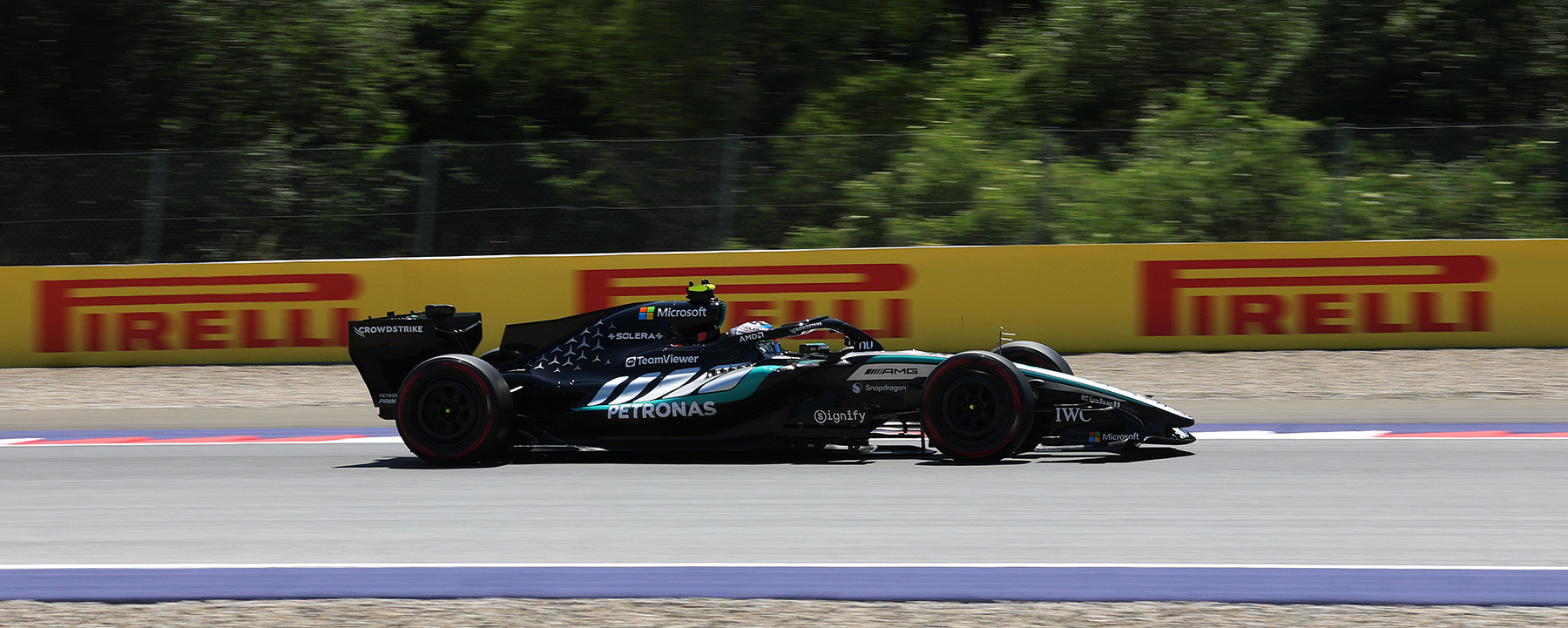
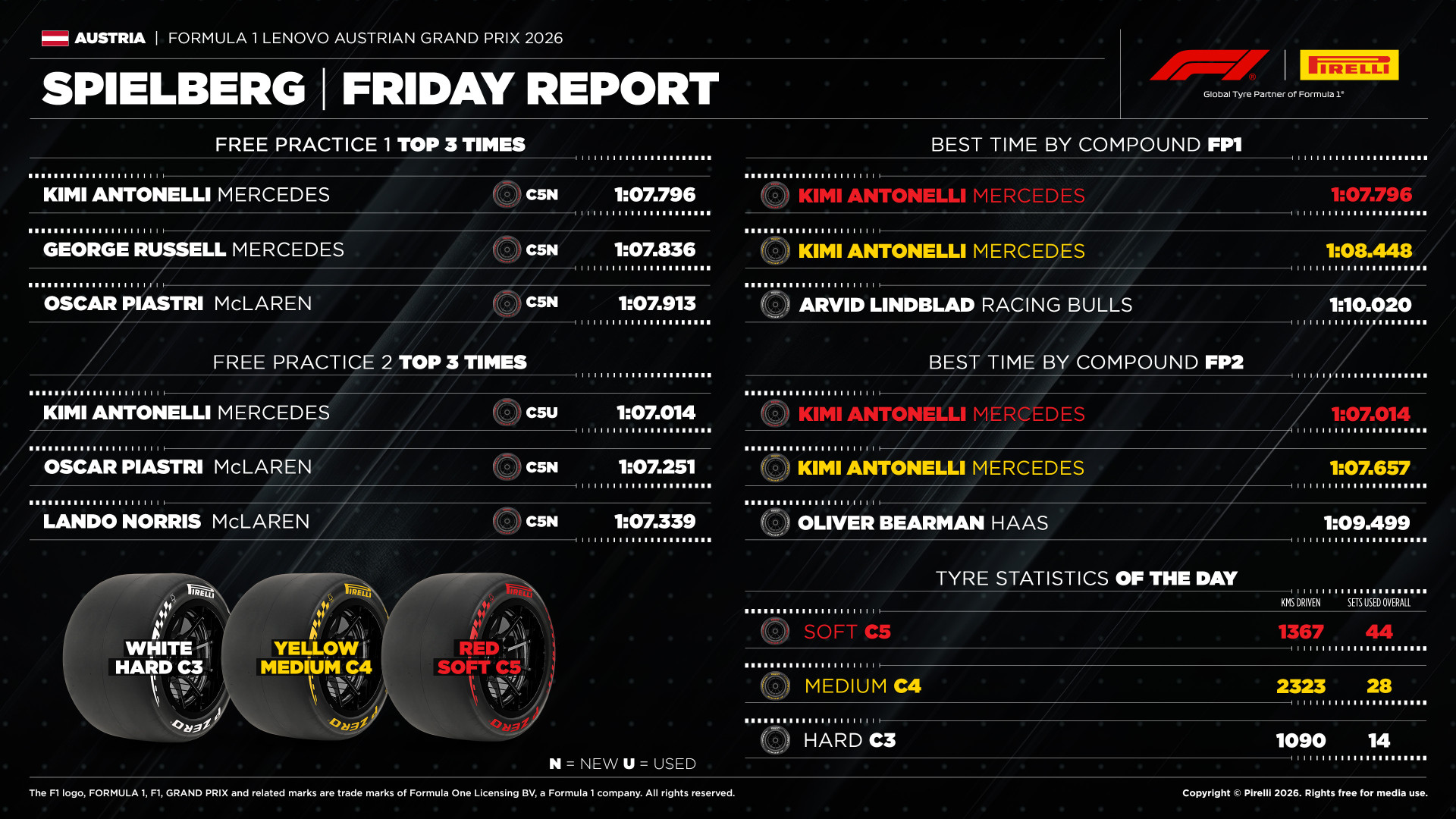
Kimi Antonelli was the fastest driver on Friday in Austria. Temperatures at the Red Bull Ring climbed to 35°C ambient and 53°C on track, conditions that did not prevent drivers and teams from making use of all the available compounds. In fact, every single compound was used in both the first and second free practice sessions.
During the first session, drivers initially focused their runs on the Medium (C4) and Hard (C3) compounds. Red Bull was the only team to take to the track straight away on the Soft (C5). By the end of FP1, however, all drivers had used the softest compound for at least one run.
If the use of the three options was evenly balanced in the opening hour, in the second session drivers favoured the Medium and Soft tyres. Antonelli set the fastest time on the C5, stopping the clock at 1:07.014. Oscar Piastri finished second, just over two-tenths adrift, while Lando Norris ended the day in third position.
The top three all completed their long runs on the Medium, a strategy adopted by most of the field, although some teams also evaluated the Soft and Hard over longer distances. This was similar to what was already seen in Barcelona and could suggest that all three options may be viable for Sunday’s race.
 SIMONE BERRA – PIRELLI CHIEF ENGINEER
“Today was very useful for gathering a significant amount of data on all the compounds, both in performance runs and in long runs. The teams differed across the two sessions between those who preferred to save both sets of Hard tyres for the coming days and those who had already used up one set of the hardest compound. This could also point towards a range of different strategies for Sunday, for which there is currently quite a wide spread of possible options.
Considering the degradation exacerbated by the high temperatures and the notably abrasive surface, a two-stop Grand Prix is more likely. In terms of grip, the C3 and C4 displayed very similar behaviour, still not optimal due to a track surface that is not in the best condition but which will improve over the weekend. The Soft, on the other hand, is already delivering very good performance and, from some attempts, it even appears that drivers can improve their time on a second lap. This will obviously need to be verified in tomorrow’s qualifying.
The red tyre was not widely used in today’s long runs, so we do not yet have a clear understanding of its consistency over high mileage, as we do for the Medium and Hard. It could therefore represent the least favourable option in defining race strategies, should teams opt for a conservative approach, also considering that the forecasts indicate a further rise in temperatures.”

FORMULA 2
In qualifying, the fastest time was set by Noel Leon, who claimed his first F2 pole position. The Mexican driver stopped the clock at 1:15.544, just edging out Alex Dunne. Third place went to Nikola Tsolov. On Sunday, these drivers will start from these exact positions, while the Saturday Sprint Race will feature a reversed grid.
Over the Austrian weekend, teams can use the two softest compounds in the range: Soft and Supersoft. The latter could last 7-8 laps at the start of the race before its performance drops below that of the Soft, making a switch more beneficial in terms of pace. However, a driver’s ability to manage the tyre could extend its usage by a few laps, providing an advantage in the second part of the race. For this reason, strategies for the Feature Race tend to converge in overall race time.
FORMULA 3
As in F2, Formula 3 also saw a maiden pole position in the championship for a driver. Hiyu Yamakoshi was the fastest on track with a time of 1:21.730. As a result, the Van Amersfoort Racing driver will start from pole position on Sunday. Alongside him will be Ugo Ugochukwu, who set the second fastest time on Friday, while Tuukka Taponen secured the third quickest lap.
The compound used over the Austrian weekend is the Soft. This year, rear tyre pressures are one psi higher and therefore drivers must carefully manage tyre balance, avoiding overheating and increased wear. Those who can do this most effectively in the early stages of the race should reap the rewards in the closing laps before the chequered flag.
Founded in 1872, Pirelli is a company with deep Italian roots now recognised all over the world for its cutting-edge technology, capacity for innovation, and the quality of its products. Motorsport has always played an important part in Pirelli’s strategy, following the ‘race to road’ philosophy. The company has been engaged in motorsport for 119 years and today supplies tyres to more than 350 championships on both two and four wheels. Pirelli pays constant attention to the most efficient use of natural resources and energy, and will reach carbon neutrality by 2030.
Pirelli has been Global Tyre Partner of the FIA Formula 1 World Championship since 2011. The company also supplies championships including FIA Formula 2, FIA Formula 3, Formula Regional European Championship by Alpine and GT World Challenge, alongside numerous national series.