









From Full Wets to Inters in qualifying, Norris takes pole in São Paulo
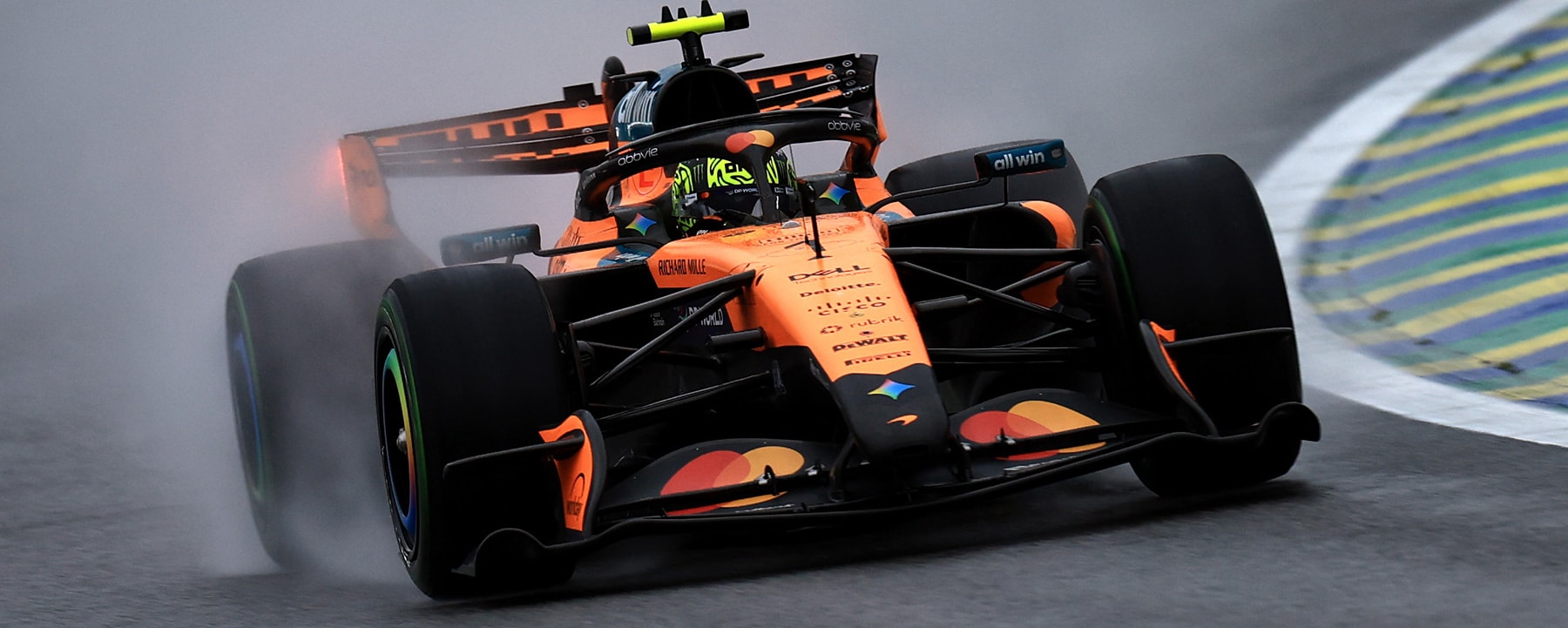
Qualifying for the São Paulo Grand Prix took place exclusively on wet-weather tyres. Heavy rain began to fall over the Interlagos circuit shortly before the start of Q1, causing standing water to form in several areas of the track.
As a result, the session start was delayed but, once Race Control deemed conditions safe, all drivers headed out on Full Wet tyres.
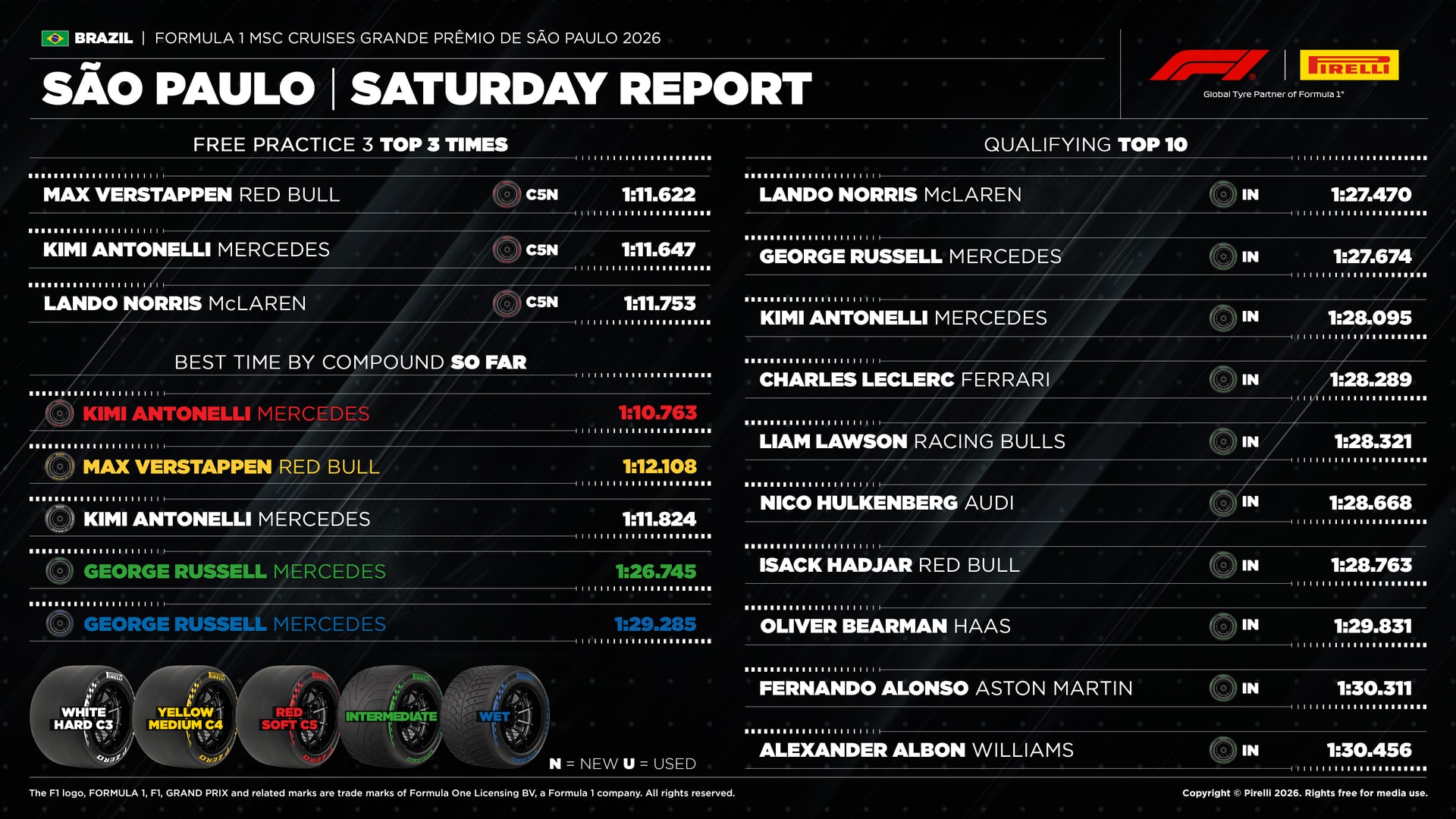
The result was a fiercely contested Q1, followed by a Q2 in which the field gradually switched to Intermediates, which were also used throughout Q3 in the continuous search for performance. With track temperatures dropping to as low as 20 °C, Lando Norris set the fastest time in Q3, stopping the clock at 1:12.470.
Behind him, George Russell secured second place with a time of 1:27.674, while Kimi Antonelli recorded the third-fastest lap in 1:28.095. During qualifying, Norris used two new sets of Full Wets and two sets of Intermediates. Russell and Antonelli each used one new set of Full Wets and two new sets of Intermediates.
Conditions in FP3 had been markedly different, with track temperatures reaching 47 °C, although accompanied by wind gusts of up to 30 km/h. Max Verstappen set the fastest time of the session in 1:11.622, ahead of Kimi Antonelli (1:11.647) and Lando Norris (1:11.753).
The quickest laps came in the second half of the session during qualifying simulations on the Soft compound. In the opening part of FP3, all drivers had run on the Medium tyre.
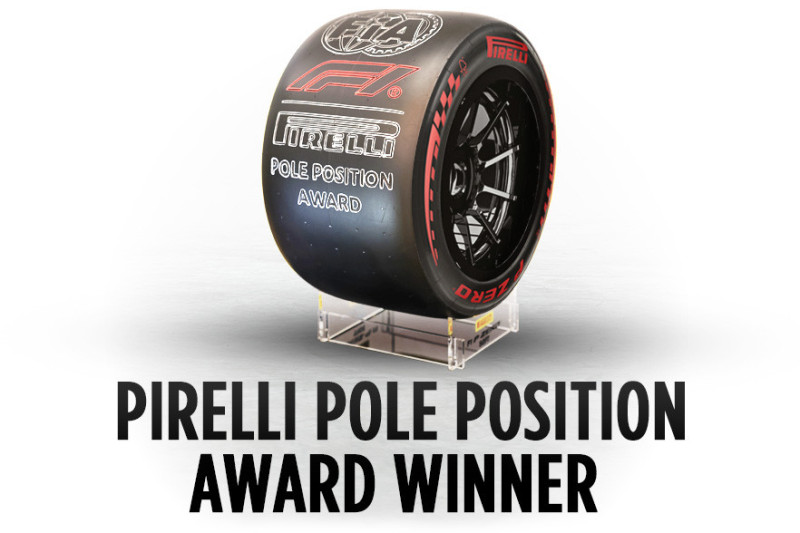
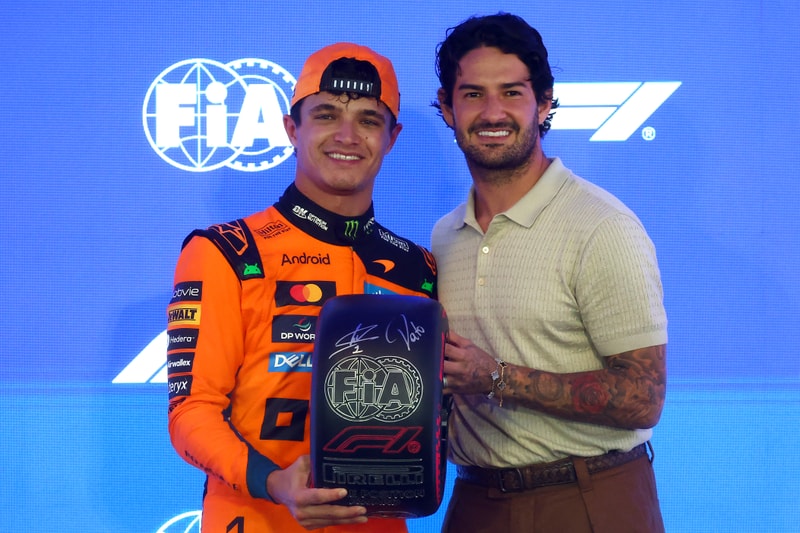
The Pirelli Pole Position Award was presented by Alexandre Pato. The former Brazilian footballer enjoyed a successful spell with AC Milan, winning both the Serie A title and the Italian Super Cup. With the Brazil national team, he won the FIFA Confederations Cup and earned two Olympic medals.
 DARIO MARRAFUSCHI – PIRELLI MOTORSPORT DIRECTOR
“Today’s qualifying session provided a clear demonstration of wet-weather racing, with the cars able to exploit the Full Wet tyre during the opening phase when track conditions remained particularly challenging. The extreme wet tyre enabled running to resume after the delay, confirming its effectiveness even in the most demanding conditions and allowing the drivers to maintain a strong level of performance.
Equally significant was the switch to Intermediates at the start of the second session. Thanks to the development work carried out over recent years on the crossover window, the Full Wet was able to remain effective even once standing water had disappeared from the circuit, making the subsequent transition to Intermediates particularly smooth as track conditions continued to improve.
Current forecasts indicate a 60% chance of rain for tomorrow’s race, meaning a scenario similar to today’s cannot be ruled out should the Grand Prix take place wholly or partly on a wet track. In dry conditions, however, the most meaningful indications come from Friday’s second free practice session, the only one that provided representative long-run data.
Analysis of the long runs has led us to revise the simulations carried out before the weekend. Wear proved higher than expected, resulting in greater performance loss over the course of a stint. For this reason, a two-stop strategy emerges as the preferred option, featuring two stints on Soft and one on Medium. This combination is estimated to offer an advantage of around three seconds over strategies involving all three available compounds. Using the Hard tyre alongside two Soft stints would result in a further increase in overall race time.
The lower temperatures expected on Sunday, combined with the possibility of a track offering less grip than was seen on Friday, could further favour the softer compounds, which provide greater grip and come up to temperature more quickly. A one-stop strategy appears significantly less competitive, with an estimated race time around ten seconds slower than the optimum two-stop approach. In this context, the undercut could prove decisive, particularly for drivers switching to a softer compound, as they would be able to exploit the immediate gain in grip to make up track position.”
Founded in 1872, Pirelli is a company with deep Italian roots now recognised all over the world for its cutting-edge technology, capacity for innovation, and the quality of its products. Motorsport has always played an important part in Pirelli’s strategy, following the ‘race to road’ philosophy. The company has been engaged in motorsport for 119 years and today supplies tyres to more than 350 championships on both two and four wheels. Pirelli pays constant attention to the most efficient use of natural resources and energy, and will reach carbon neutrality by 2030.
Pirelli has been Global Tyre Partner of the FIA Formula 1 World Championship since 2011. The company also supplies championships including FIA Formula 2, FIA Formula 3, Formula Regional European Championship by Alpine and GT World Challenge, alongside numerous national series.